




By Todd Manley, Director of Government Relations
Every year, the Sacramento Valley is home to some of the most remarkable wildlife migrations in North America. Chinook salmon move from our rivers to the Pacific Ocean and eventually return to the waters where their lives began. At the same time, millions of ducks, geese and shorebirds travel along the Pacific Flyway, using the Sacramento Valley as an essential place to rest, feed and prepare for the next leg of their journeys.
A new Floodplain Forward publication, Investing in Life on the Move, illustrates an increasingly important principle for the Sacramento Valley: healthy rivers depend on healthy landscapes, and reconnecting water with the landscape at the right time can provide extraordinary benefits for fish and wildlife.
Sun, Land and Water
The productivity of the Sacramento Valley begins with a remarkably simple combination—sun, land and water.
When water spreads across bypasses, ricelands, wildlife refuges and riparian areas, it interacts with sunlight and fertile soils to create highly productive food webs. Scientists often describe the energy generated by these food webs as “energetics”—the nourishment wildlife needs to grow, migrate and avoid predators.
 This landscape-scale productivity is particularly important for juvenile salmon.
Water spreading across floodplains, including winter-flooded rice fields, produces abundant zooplankton and aquatic insects that provide food for young Chinook salmon. Research shows that salmon exposed to these floodplain food webs can grow substantially faster than salmon rearing only in river channels, helping them become larger and stronger as they begin their migration toward the Pacific Ocean.
There is an important lesson emerging from this science: floodplains can help salmon in multiple ways. Food generated on the floodplain can be transported into rivers, while in other circumstances juvenile salmon can directly access productive floodplain habitats.
This understanding is helping shape a more holistic approach to salmon recovery throughout the Sacramento Valley. As the map on page 5 demonstrates, floodplain reactivation is one element of a much broader portfolio that includes source-water protection, temperature management, spawning gravels and refugia, fish passage, pulse flows, hatchery modernization and enhancements on tributaries throughout the watershed.
 A Landscape for Birds on the Pacific Flyway
The same landscapes that support salmon also sustain one of the most important bird migration corridors in the Western Hemisphere.
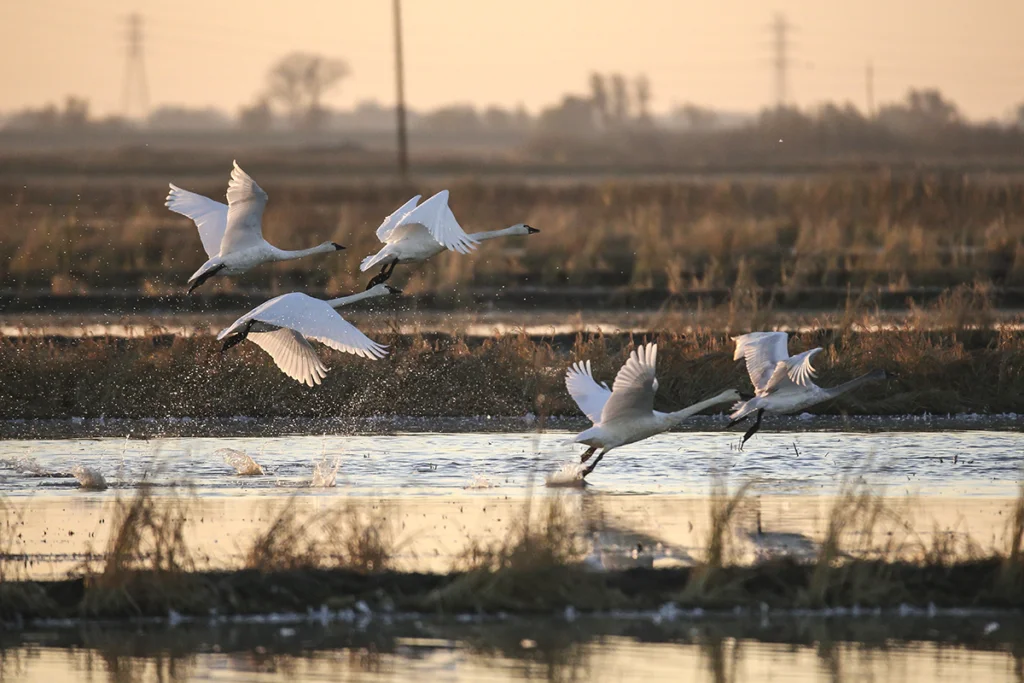
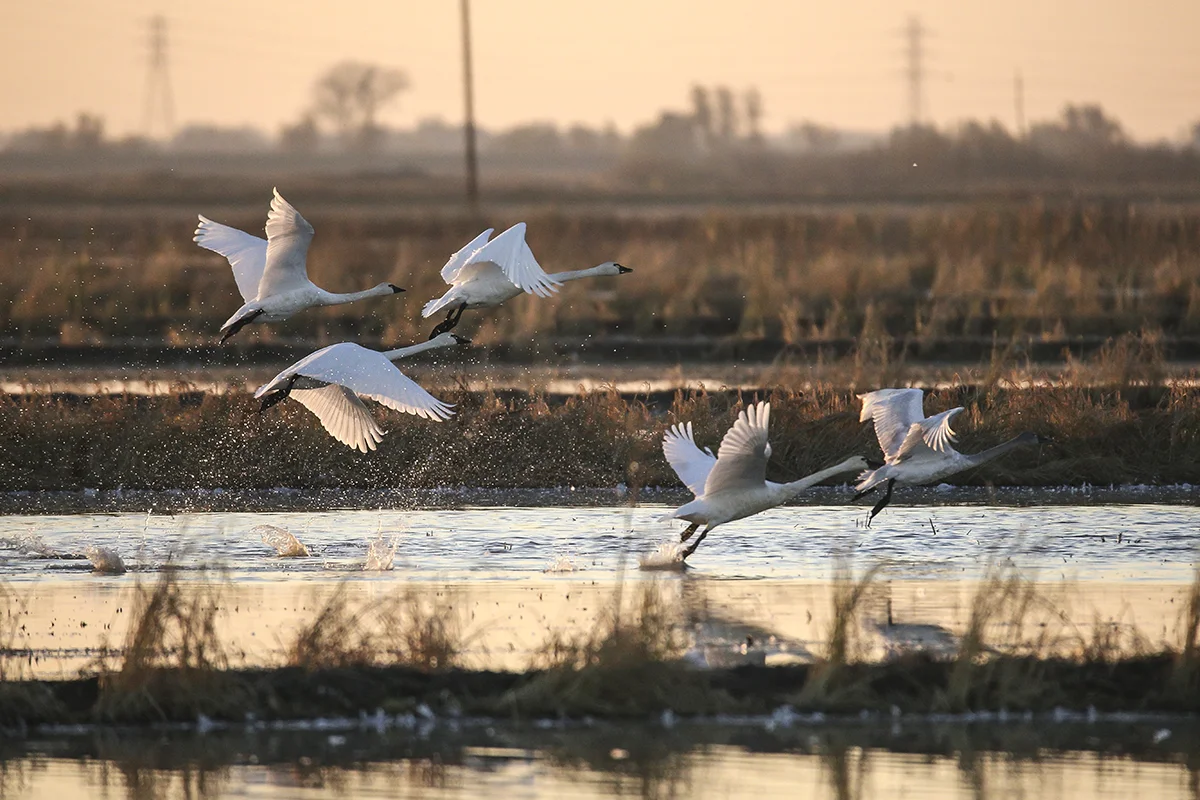
The Sacramento Valley is a critical stop along the Pacific Flyway, where working ricelands, wetlands, bypasses, and refuges provide migrating birds with food and places to rest. We estimate that four million waterfowl and as many as 350,000 shorebirds rely on Sacramento Valley ricelands, bypasses, and refuges each winter.
Ricelands are particularly important. Sacramento Valley ricelands provide more than 60 percent of the winter diet for millions of ducks, geese and other waterfowl, helping birds build the energy reserves necessary for migrations that extend thousands of miles to Arctic breeding grounds.
 A Holistic Approach for Salmon
Salmon embody “life on the move,” connecting the Sacramento Valley’s mountain headwaters, rivers and floodplains with the Pacific Ocean. The Sacramento Valley’s holistic approach seeks to “give salmon a chance” by improving freshwater conditions for every life stage of all four runs of Chinook salmon—from ridgetop to river mouth. This means protecting cold source waters, restoring spawning gravels and side channels, improving fish passage, managing water temperatures and seasonal flows, and reactivating floodplains that provide abundant food and safe places for young salmon to grow. Complementary efforts include modernizing hatcheries, addressing thiamine deficiency and returning salmon to historic habitats. By bringing water managers, farmers, tribes, scientists, conservation organizations and public agencies together, this approach reconnects water and land to support salmon throughout their remarkable journeys while sustaining the communities, farms and wildlife that share these landscapes.

Dynamic Conservation Across a Working Landscape
Perhaps the most important message in Investing in Life on the Move is that these ecological benefits do not depend on separating people from the landscape.
They depend on actively managing the landscape.
Farms, wildlife refuges, bypasses and private wetlands can work together as an interconnected system. By strategically putting water on the landscape at the right times and places, landowners, conservation organizations, water managers and scientists can create habitat while maintaining productive working lands.
This is the approach behind Floodplain Forward, a coalition of 35 organizations representing landowners, irrigation districts, higher education and conservation groups. The coalition describes this collaborative model as “dynamic conservation”—using farms, refuges and managed wetlands to provide habitat for waterfowl and shorebirds while also supporting food production for fish species.
That collaboration reflects a larger vision emerging throughout the Sacramento Valley: rather than managing rivers, farms, wetlands and wildlife independently, we can manage them as parts of the same living system.
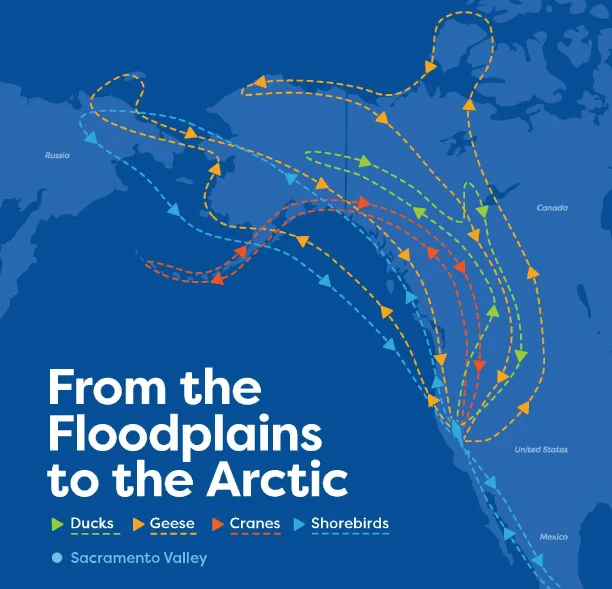
The maps in the document bring these connections to life. Salmon leaving the Sacramento River disperse throughout the Pacific Ocean before returning to their natal rivers, while ducks, geese, cranes and shorebirds move north and south across a migration network stretching from California into Canada, Alaska and beyond. The Sacramento Valley sits at the center of both remarkable journeys.

Moving the Floodplain Forward
For generations, the Sacramento Valley has supported people, farms, fish and wildlife. The science now gives us an opportunity to manage these landscapes even more intentionally.
By reconnecting rivers and floodplains where possible, strategically managing water across working lands, investing in wildlife refuges and wetlands, and continuing to advance collaborative science, we can increase the productivity of the landscape for salmon, waterfowl and shorebirds alike.
The journeys may stretch from the Sacramento River to the Pacific Ocean—or from the Sacramento Valley to the Arctic—but many of them begin with the same fundamental ingredients: sun, land and water.
And by investing in these landscapes, the Sacramento Valley can continue investing in life on the move.
For more information, please see Investing in Life on the Move and the Floodplain Forward Coalition website.